
Sawan 2026 runs July 30 – August 28 in North India, with four Somwar fasts on August 3, 10, 17, and 24, and Sawan Shivratri on August 11. The month marks when Lord Shiva drank the Halahala poison during Samudra Manthan to save creation. Devotees mark it with fasting, Rudrabhishek, Bel Patra offerings, and pilgrimages to Jyotirlingas like Kedarnath.
| Event | Date (2026) | Region / Calendar |
|---|---|---|
| Sawan start | July 30 (Thursday) | North India (Purnimanta) |
| Sawan end | August 28 (Friday) | North India (Purnimanta) |
| 1st Sawan Somwar | August 3 | North India |
| 2nd Sawan Somwar | August 10 | North India |
| 3rd Sawan Somwar | August 17 | North India |
| 4th Sawan Somwar | August 24 | North India |
| Sawan/Shravan Shivratri | August 11 | North India |
| Raksha Bandhan / Shravan Purnima | August 28 | North India |
| Shravan start | August 13 | South & West India (Amanta) |
| Shravan end | September 11 | South & West India (Amanta) |
| Kedarnath Temple opening | April 22, 2026 | Uttarakhand |
| Kedarnath Temple expected closing | Late Oct / early Nov 2026 (Bhai Dooj) | Uttarakhand |
North Indian states (Uttar Pradesh, Rajasthan, Madhya Pradesh, Punjab, Himachal Pradesh, Uttarakhand, Chhattisgarh, Bihar, Jharkhand) follow the Purnimanta calendar, counting a month full-moon to full-moon. South and West Indian states (Maharashtra, Gujarat, Karnataka, Andhra Pradesh, Telangana, Tamil Nadu, Goa) follow the Amanta calendar, counting new-moon to new-moon — hence the roughly two-week gap. Neither is “more correct”; they’re regional conventions applied to the same lunar cycle.
| Attribute | Detail |
|---|---|
| Also known as | Shravan, Shravana Maas |
| Position in Hindu calendar | 5th lunar month |
| Name origin | Shravana Nakshatra, which rules the month’s Purnima (full moon) |
| Season | Monsoon |
| Primary deity | Lord Shiva |
| Calendar system (North India) | Purnimanta (full moon to full moon) |
| Calendar system (South/West India) | Amanta (new moon to new moon) |
| Nepal / parts of Uttarakhand-Himachal | Anchored to Karka Sankranti in some communities |
The two calendar systems aren’t an error in either direction — they’re both legitimate, long-standing regional conventions. The rituals, fasting rules, and puja practices are essentially identical once the month begins; only the start/end window shifts by region. If unsure which applies, follow whatever your family or local temple observes.
| Mythological Element | Meaning |
|---|---|
| Samudra Manthan | Cosmic churning of the ocean by Devas and Asuras, using Mount Mandara and the serpent Vasuki, to extract Amrita (nectar of immortality) |
| Halahala | Deadly poison released before Amrita emerged; threatened to destroy all worlds |
| Shiva drinking the poison | He held it in his throat rather than swallowing (which would kill him) or spitting it out (which would destroy creation) |
| Neelkanth | Shiva’s name meaning “blue-throated one,” from the poison’s effect |
| Ganga poured on Shiva’s head | Gods’ method of cooling him after the poison raised his body heat |
| Crescent moon on his head | A further cooling symbol, worn ever since |
| Indra’s rainfall | Mythological root of why Sawan (peak monsoon) is Shiva’s season |
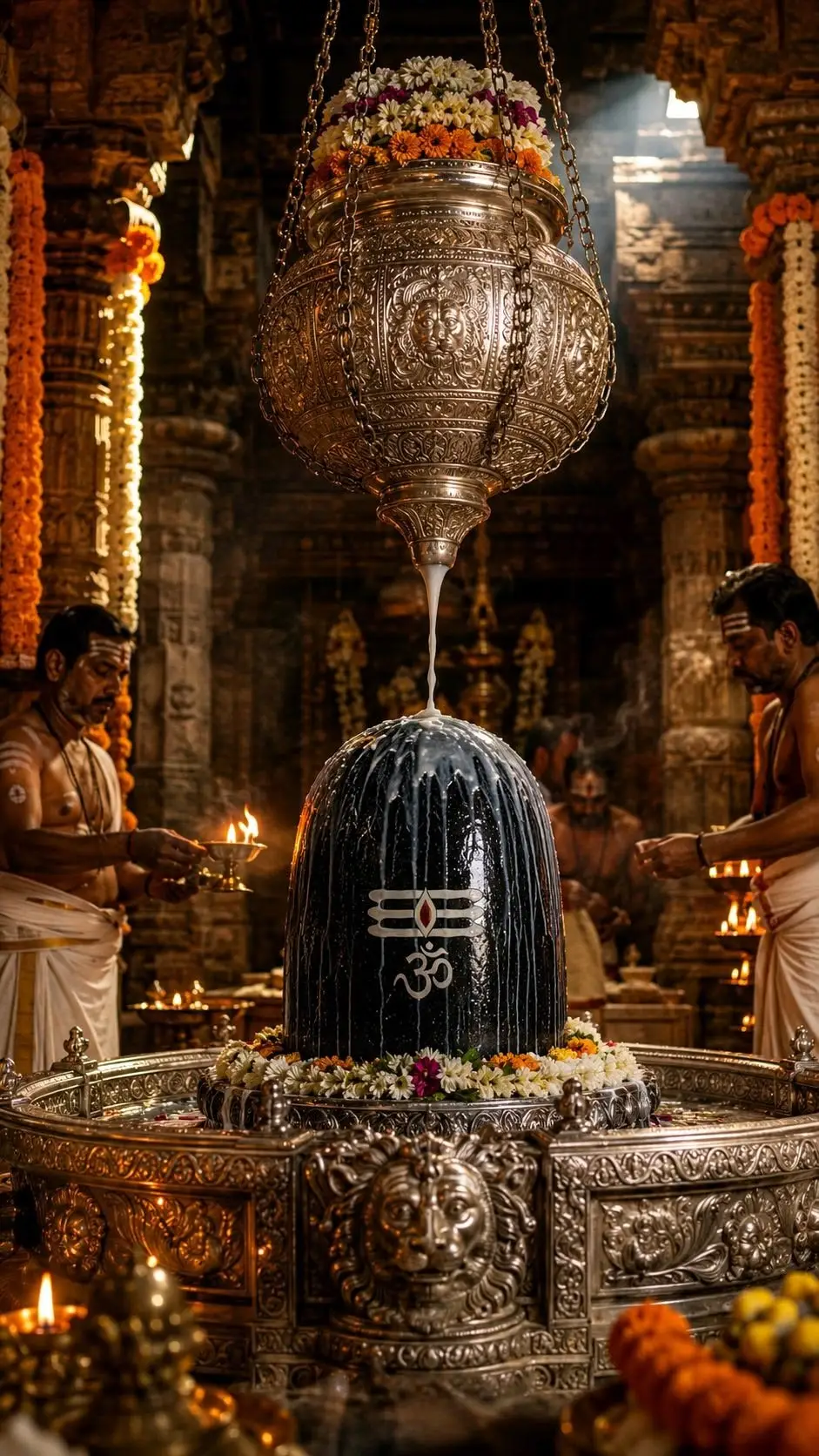
| Jalabhishek / Milk Abhishek | Ritual continuation of that original cooling act — every offering poured today echoes the gods’ original relief-giving gesture |
The Halahala story isn’t just a heroic-rescue tale — it’s the template for how Shiva is understood theologically: the deity who absorbs what nobody else can bear, from literal poison to psychological suffering. Fasting and self-discipline during Sawan is devotees enacting a smaller version of that same containment.
Scriptural basis: The Shiva Purana details Shiva’s supremacy and correct worship methods, including the lingam’s symbolism. The Skanda Purana covers pilgrimage sites (tirtha-mahatmya) tied to Shiva, including Himalayan regions. The Linga Purana focuses on lingam theology as the union of the formless and the formed.
| Theme | What It Means in Practice |
|---|---|
| Meditation | Monsoon slows outdoor life; used as a window for inward focus |
| Forgiveness | Resolving old family conflicts before Raksha Bandhan |
| Detachment (Vairagya) | A month of wanting less — food restrictions, simpler living |
| Compassion | Shiva absorbing poison as a model for costly compassion |
| Self-discipline | Early rising, cold-water bathing, fasting through a working day |
| Transformation | Seasonal shift from pre-monsoon heat to green monsoon mirrors inner change |
| Connection with nature | Bel leaves, river water, rice offerings tie worship to the living landscape |
| Question | Answer |
|---|---|
| What is it | Fasting on Mondays falling within Sawan, dedicated to Shiva |
| 2026 dates | August 3, 10, 17, 24 |
| Why Monday | “Somwar” derives from Soma (the moon), which rests on Shiva’s head |
| Who commonly observes | Unmarried women (praying for a partner), married women (husband’s health/family wellbeing), men and families generally (health, prosperity, obstacle removal) |
| Extended version | Solah Somwar Vrat — 16 consecutive Monday fasts starting in Sawan |
| Who should generally avoid strict fasting | Pregnant women, diabetics or those on regular medication, young children, elderly with health vulnerabilities, anyone acutely unwell |
| Common mistake #1 | Fasting without enough hydration in monsoon heat/humidity |
| Common mistake #2 | Treating it purely as a diet plan rather than a spiritual discipline |
| Common mistake #3 | Skipping the puja while keeping the fast — most traditions treat these as paired |
| Common mistake #4 | Breaking the fast with heavy, oily food at night |
| Step | Action |
|---|---|
| 1 | Wake before sunrise, bathe (cold water traditionally) |
| 2 | Wear clean, simple/light-colored clothing |
| 3 | Visit a Shiva temple or set up home worship |
| 4 | Perform Jalabhishek or full Rudrabhishek |
| 5 | Offer Bel Patra, white flowers, fruits |
| 6 | Chant Om Namah Shivaya or Mahamrityunjaya Mantra |
| 7 | Eat once after sunset, or maintain fruit/milk-only diet |
| 8 | Avoid grains, onion, garlic, non-vegetarian food |
| 9 | Avoid negative speech and unnecessary travel |
| Offering | Symbolism |
|---|---|
| Water (Jal) | Purity, cooling, life itself |
| Milk | Nourishment, purity, prosperity |
| Curd (Dahi) | Growth and multiplication of positive outcomes |
| Honey (Madhu) | Sweetness in speech and disposition |
| Sugar | Removal of bitterness and sorrow |
| Ghee | Strength, victory, sustained energy |
| Bel Patra (Bilva leaves) | Shiva’s most beloved offering; trifoliate leaf represents his three eyes / the trimurti |
| Dhatura | Accepted despite toxicity, symbolizing Shiva’s protection even from harmful things offered in good faith |
| Bhaang | Linked to Shiva’s ascetic, unconventional nature as Bholenath |
| White flowers | Purity and simplicity |
| Fruits | Gratitude, offering back the “fruits” of one’s actions |
| Incense (Dhoop) | Purification of atmosphere and mind |
| Lamp (Deepak) | Inner light of awareness overcoming ignorance |
| Step | Action |
|---|---|
| 1 | Clean the puja area and Shivling/image |
| 2 | State your Sankalp (intention) |
| 3 | Abhishek with water, then milk, curd, honey, sugar, ghee (or as combined Panchamrit) |
| 4 | Rinse with plain water after each substance |
| 5 | Offer Bel Patra, smooth side facing the Shivling |
| 6 | Offer white flowers (avoid Kesar/Ketki flowers) |
| 7 | Apply Chandan (sandalwood) or Vibhuti (sacred ash) |
| 8 | Light incense and lamp; perform Aarti |
| 9 | Chant Om Namah Shivaya / Mahamrityunjaya / Rudram |
| 10 | Close with a prayer of gratitude |
| Aspect | Detail |
|---|---|
| What it is | Elaborate ritual bathing of the Shivling while chanting Rudram/Rudra mantras |
| Typically performed by | A priest, often on behalf of a specific intention |
| Common intentions | Health, career obstacles, marital harmony, family wellbeing |
| Materials | Same as standard Abhishek, performed with greater ritual precision and mantra counts |
| Availability | Major temples (including Jyotirlingas) offer paid Rudrabhishek bookings, especially in Sawan |
| Mantra | Source | Primary Use | Traditional Chanting Count | Best Time |
|---|---|---|---|---|
| Om Namah Shivaya | Traditional Shaiva practice | General devotion, any occasion, all practice levels | Multiples of 108 | Sunrise, sunset, Pradosh Kaal (~90 min before sunset) |
| Mahamrityunjaya Mantra | Rig Veda | Healing, protection, overcoming fear of death/illness | 108 | Monday, Sawan Shivratri |
| Rudram (Sri Rudram) | Yajurveda (Namakam + Chamakam) | Comprehensive invocation of Shiva across many aspects; used in Rudrabhishek | Full recitation, typically by trained priests | During elaborate Rudrabhishek ceremonies |
The Mahamrityunjaya Mantra’s content is an invocation of Shiva as the three-eyed nourisher of all beings, asking for release the way a ripe cucumber separates from its vine — a metaphor for liberation from suffering, not literally about avoiding death. If new to Sanskrit chanting, sincere intention is traditionally held to matter more than perfect pronunciation, though for something as long as the full Rudram, working with a priest is genuinely useful.
| Category | Items |
|---|---|
| Fasting-allowed | Fruits, milk/dairy, sabudana (sago), singhara atta (water chestnut flour), kuttu atta (buckwheat flour), potatoes, sendha namak (rock salt), nuts, coconut |
| Commonly avoided | Onion, garlic, non-vegetarian food, eggs, regular table salt (on fast days), grains (wheat/rice, on fast days), alcohol |
| Popular fasting dishes | Sabudana khichdi, kuttu ki puri, singhare ke pakode, fruit chaat, makhana kheer |
| Regionally avoided | Leafy greens (monsoon insect/bacteria concern, practical food-safety logic underneath the religious custom) |
| Maharashtra/Gujarat pattern | Simple home-cooked sattvic meals through the whole Amanta Shravan window rather than single strict fast days |
| Category | Practices Commonly Avoided |
|---|---|
| Dietary | Non-vegetarian food, alcohol (month-long or at minimum on fasting days) |
| Grooming (regional) | Hair cuts, shaving, nail-cutting on Mondays in some traditions |
| Lifestyle | Starting major new ventures or purchases on inauspicious tithis |
| Conduct | Harsh speech, unnecessary arguments |
| Travel (practical, not ritual) | Rigid, non-flexible itineraries on Himalayan routes — monsoon brings real landslide/road-closure risk |
Most of these customs function as a monthlong nudge toward simpler living and lower friction — visitors and NRIs unfamiliar with regional rules shouldn’t feel obligated to follow every one; the core practice (fasting, puja, mantra, temple visits) matters most broadly.
| Dimension | Commonly Cited Benefit |
|---|---|
| Mental | Improved focus, reduced anxiety from structured monthlong practice |
| Physical | Lighter eating and reduced alcohol/non-veg intake during infection-prone monsoon |
| Family | Shared fasting, temple visits, and Raksha Bandhan strengthen bonds |
| Career | Prayers for obstacle removal, addressed to Shiva as Aashutosh (“easily pleased”) |
| Relationships | Marriage and marital-harmony prayers, tied to Shiva-Parvati mythology |
| Spiritual growth | Overall slower, more reflective monthlong state of mind |
| Temple | State | Known For | Sawan Crowd Level | Calendar Followed |
|---|---|---|---|---|
| Kedarnath | Uttarakhand | Himalayan trek, Char Dham, Jyotirlinga | Very high, weather-dependent | North Indian (Purnimanta) |
| Triyuginarayan | Uttarakhand | Site of Shiva-Parvati wedding, Akhand Dhuni fire | Moderate | North Indian |
| Kashi Vishwanath | Uttar Pradesh | Ganga-side Jyotirlinga, Mangala Aarti | Extremely high | North Indian |
| Mahakaleshwar | Madhya Pradesh | Bhasma Aarti (unique among Jyotirlingas) | Very high | North Indian |
| Somnath | Gujarat | Historic, repeatedly rebuilt shrine | High | Amanta |
| Omkareshwar | Madhya Pradesh | Narmada island temple, Om-shaped island | High | North Indian |
| Trimbakeshwar | Maharashtra | Trimurti lingam, near Godavari source | High | Amanta |
| Baidyanath | Jharkhand | Kanwar Yatra destination, healing association | Extremely high | North Indian |
| Grishneshwar | Maharashtra | Smallest Jyotirlinga structure, near Ellora Caves | Moderate | Amanta |
| Rameshwaram | Tamil Nadu | Southern Char Dham, Rama’s Shiva worship site | High | Amanta |
| Temple | History/Significance | Best Time to Visit | How to Reach | Nearby Attractions |
|---|---|---|---|---|
| Kedarnath | One of 12 Jyotirlingas; part of Char Dham; ~3,583m altitude | Open season Apr–Oct/Nov; Sawan = monsoon conditions | 16–18km trek or helicopter from Gaurikund/Sonprayag | Vasuki Tal, Bhairav Temple, Gandhi Sarovar |
| Triyuginarayan | Traditional Shiva-Parvati marriage site; Vishnu as officiant | Year-round; pairs well with Kedarnath trip | Road-accessible near Guptkashi | Guptkashi temples, Kedarnath route |
| Kashi Vishwanath | Major Jyotirlinga on the Ganga in Varanasi | Early morning Mangala Aarti; expect heavy Sawan Monday crowds | Well-connected by road/rail/air to Varanasi | Ganga ghats, Vishwanath Corridor |
| Mahakaleshwar | Jyotirlinga famous for pre-dawn Bhasma Aarti | Book Bhasma Aarti in advance during Sawan | Well-connected to Ujjain city | Ujjain temple circuit |
| Somnath | Jyotirlinga rebuilt multiple times; coastal Saurashtra | Amanta Shravan window (mid-Aug to mid-Sep) | Well-connected to Veraval/Somnath town | Saurashtra coastline |
| Omkareshwar | Narmada-island Jyotirlinga; site of Kedarnath opening-date announcement | Year-round | Road-accessible near Indore | Narmada river ghats |
| Trimbakeshwar | Trimurti-representing lingam near Godavari source | Amanta Shravan window | Near Nashik | Godavari source, Nashik temples |
| Baidyanath | Healing-associated Jyotirlinga; Kanwar Yatra endpoint | Extremely crowded through Sawan | Deoghar, Jharkhand | Kanwar Yatra route from Sultanganj |
| Grishneshwar | Smallest Jyotirlinga structure | Combine with Ellora visit | Near Aurangabad/Chhatrapati Sambhajinagar | Ellora Caves |
| Rameshwaram | Southern Char Dham; Rama’s Shiva worship legend | Amanta Shravan window | Well-connected to Tamil Nadu rail network | Dhanushkodi, Pamban Bridge |
| Category | Details |
|---|---|
| Altitude | ~3,583 metres |
| 2026 opening date | April 22, 8:00 AM |
| 2026 expected closing | Late October / early November (Bhai Dooj) |
| Weather in Sawan | Frequent rain, low visibility, cold even in August |
| Trek distance | 16–18 km from Gaurikund/Sonprayag, 6–8 hours one way |
| Helicopter option | From Phata, Sersi, Guptkashi; weather-dependent, delays common — see Char Dham Yatra by Helicopter |
| Registration | Mandatory, free, via registrationandtouristcare.uk.gov.in; checked at Sonprayag |
| Key risk in Sawan | Landslides and road closures on the approach roads |
| Packing essentials | Waterproof jacket, quick-dry clothes, waterproof trekking shoes, trekking pole, medication, power bank, ID copies |
| Recommended approach | Flexible itinerary, no fixed same-day return plans — see Hotels in Kedarnath for stay options |
| Aspect | Detail |
|---|---|
| Central legend | Site of Shiva and Parvati’s wedding, with Vishnu as officiant (Kanyadaan) and Brahma conducting the rites |
| Defining feature | Akhand Dhuni — fire believed to have burned continuously since the wedding |
| Sawan significance | Increased visits from couples seeking marital blessings, tied to the month’s Shiva-Parvati theme |
| Access | Low altitude, road-accessible, easy add-on to Kedarnath/Guptkashi itinerary |
| Nearby | Guptkashi hospitality corridor, staging point for Kedarnath yatra |
| Practice | Traditional Meaning | Parallel Modern Observation |
|---|---|---|
| Meditation/chanting | Inner purification | Associated with reduced stress, improved attention regulation |
| Fasting | Spiritual discipline, detachment | Periodic fasting studied for potential metabolic effects (not a substitute for medical guidance) |
| Cold water bathing | Ritual purity | Anecdotally linked to alertness/circulation; avoid if unsafe |
| Seasonal light eating (Ayurveda’s Varsha Ritu) | Aligns with sattvic dietary custom | Ayurveda independently associates monsoon with weaker digestion (Agni) and higher infection risk |
| Structured daily/monthly routine | Devotional discipline | Behavioral research links external structure to reduced decision fatigue, improved consistency |
| Element | Ecological Connection |
|---|---|
| Monsoon timing | Rains that cool Shiva mythologically are the same rains recharging rivers and groundwater |
| Bel Patra offerings | Depend on healthy Bel (wood apple) tree populations |
| River water offerings | Depend on clean, flowing rivers |
| Kanwar Yatra | Pilgrims physically carry Ganga water for hundreds of km, historically reinforcing river-cleanliness investment |
| Modern temple practice | Increasing push for biodegradable offerings, reduced plastic near river ghats during Sawan crowds |
July 30 to August 28 in North India; roughly August 13 to September 11 in South/West India.
August 3, 10, 17, and 24 (North Indian calendar).
Sawan Shivratri is on August 11, 2026.
It marks when Shiva drank the Halahala poison during Samudra Manthan to save creation; the month honors and cools that act through worship.
Yes — commonly done while praying for a compatible life partner, following Parvati's own devotion to Shiva.
Yes, typically for their husband's health and the family's wellbeing.
Yes, for career, health, and general spiritual merit, though it's more commonly associated with women in popular practice.
No — styles vary from complete fasting to fruit-and-milk diets to a single evening meal.
Water, milk, curd, honey, sugar, ghee (or Panchamrit), Bel Patra, white flowers, and fruits.
The trifoliate leaf symbolizes his three eyes and the trimurti; considered his most beloved offering.
Continues the mythological cooling of Shiva after he drank the Halahala poison; also represents purity and nourishment.
"Somwar" derives from Soma (the moon), which Shiva wears on his head.
An elaborate ritual bathing of the Shivling with Vedic Rudra mantras, usually by a priest, for specific intentions.
Clean the space, state intention, perform Abhishek, offer Bel Patra and flowers, light a lamp/incense, chant, and close with gratitude.
Om Namah Shivaya — simple and appropriate at any time or practice level.
Healing, protection, and overcoming fear of death or serious illness.
Onion, garlic, non-vegetarian food, alcohol, and regular grains on strict fasting days.
Fruits, milk, sabudana, kuttu/singhara flour, potatoes, nuts, and rock salt.
Ayurveda links monsoon to weaker digestion and higher infection risk, aligning with lighter eating patterns.
Most guidance recommends a modified fast or none at all — decide with family and a doctor.
A pilgrimage where devotees carry Ganga water on foot, often hundreds of km, to temples like Baidyanath in Deoghar.
Somnath, Mallikarjuna, Mahakaleshwar, Omkareshwar, Kedarnath, Bhimashankar, Kashi Vishwanath, Trimbakeshwar, Baidyanath, Nageshwar, Rameshwaram, Grishneshwar.
Yes — open April 22 through roughly late Oct/early Nov 2026, covering the entire Sawan window.
Requires more caution than shoulder seasons due to landslide/road-closure risk; helicopter travel and flexible dates are recommended.
Most major temples welcome respectful visitors; inner sanctum rules vary by temple.
A new-moon day within Sawan celebrating monsoon greenery, marked with tree planting and swing (jhula) festivities in various regions.
A Tuesday fast during Shravan dedicated to Goddess Parvati (Gauri), for marital happiness.
Yes — it falls on Shravan Purnima, August 28, 2026, the last day of North Indian Sawan.
Same month — Shravan is the formal Sanskrit name, Sawan the colloquial North Indian form.
| Item | Date |
|---|---|
| Sawan starts | July 30, 2026 |
| Sawan Somwar 1 | August 3 |
| Sawan Somwar 2 | August 10 |
| Sawan Shivratri | August 11 |
| Sawan Somwar 3 | August 17 |
| Sawan Somwar 4 | August 24 |
| Sawan ends / Raksha Bandhan | August 28 |
| Ritual | Do |
|---|---|
| Waking | Before sunrise, bathe |
| Worship | Jalabhishek or Rudrabhishek |
| Offerings | Bel Patra, water, milk, white flowers |
| Chanting | Om Namah Shivaya or Mahamrityunjaya Mantra |
| Fasting | Monday fasts, per personal capacity |
| Diet | Avoid onion, garlic, non-veg, alcohol on fast days |
| Pilgrimage | Visit a Jyotirlinga or local Shiva temple |
| Himalayan travel | Plan Kedarnath/Triyuginarayan with monsoon-flexible dates and gear |