
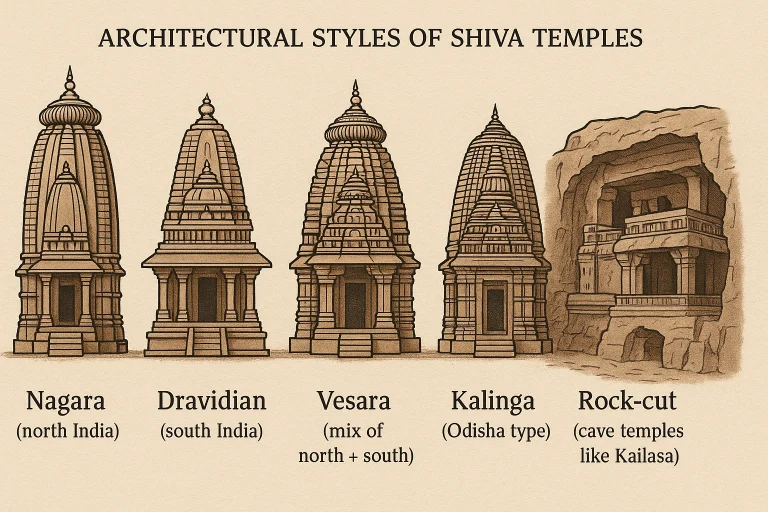
Shiva temples are very old. Families visit them to pray and feel calm. Temples were made in many places in India. Builders used local stone, brick, and art. Over time, different styles grew. Each style has its own look. This guide will teach you about the main styles in a simple way.
Main temple styles
- Nagara (north India)
- Dravidian (south India)
- Vesara (mix of north + south)
- Kalinga (Odisha type)
- Rock-cut (cave temples like Kailasa)
1. Nagara style (North India)
Nagara is the common style in the north. Temples have a tall curved tower called a shikhara. The inner room (garbhagriha) is under the highest part. The outside has many little towers and carvings. There is no big outer wall like in south temples. Famous Nagara temples show fine stone work that families like to see.
Key things to spot in Nagara
- Curved top tower (shikhara).
- Square base and no high wall.
- Carved scenes on outside walls.
- Often many small towers around the main one.
2. Dravidian style (South India)
Dravidian style grows in the south. It has a big gate tower called a gopuram at the front. The main tower over the sanctum is called vimana. The area may have many halls and pillared porches. Temples like this often have a big open space for a family to walk or sit. The Chola great temple at Thanjavur is a top example. This Dravidian group is listed by UNESCO as a world heritage set of temples.
Key things to spot in Dravidian
- Tall gopuram gate at the entrance.
- Big square tower (vimana) over the main room.
- Long halls with many pillars.
- Stone or granite build for strength.
3. Vesara style (mix of north + south)
Vesara is a blend of north and south styles. It grew in the Deccan area like Pattadakal and Hampi. Builders mixed curved shikharas and south-style towers. The result looks like both styles at once. Many fine carvings and small shrines stand together. Families can see both forms in one place.
4. Kalinga style (Odisha)
Kalinga is the style of Odisha. Temples have a curving tower like Nagara but with local rules. There is a deul (sanctum) and a jagamohana (porch). Konark Sun Temple is a top piece of this art. Konark shows how rich the stone work can be in Odisha.
5. Rock-cut temples (cave and monolithic)
Rock-cut temples are carved from one rock or inside a rock face. Kailasa at Ellora is carved from a single rock and is very big. These temples are like sculptures cut from cliffs. They show skilled work by many hands over many years. Families love to visit these carved sites.
Simple comparison table
Style | Where seen | Main look | Famous example |
Nagara | North India | Curved shikhara tower | Khajuraho, Kashi temples. |
Dravidian | South India | Gopuram gates and vimana | Brihadeeswarar (Thanjavur). |
Vesara | Deccan | Mix of north + south forms | Pattadakal, Hampi. |
Kalinga | Odisha | Deul + jagamohana plan | Konark Sun Temple. |
Rock-cut | Cave areas | Carved from single rock | Kailasa, Ellora. |
Materials and craft
Temples used rock, stone, brick, and sometimes mortar. North temples often used sandstone or granite. South temples used hard granite. In Odisha, fine sandy stone was used. Rock-cut used the rock that stood at the place. Carvers made many small figures and scenes. Families can look at the walls and see old stories in stone.
Plan of a Shiva temple
- Entrance gate (may be a tall gopuram).
- Courtyard for family to walk.
- Hall (mandapa) for people to sit.
- Inner room (garbhagriha) with the Shiva sign (lingam).
- Tower over the inner room (shikhara or vimana).
Decoration and Symbols
Shiva temples often show:
- Shiva in many poses.
- Nandi, the bull, near the door.
- Carved tales from old books.
- Floral and animal designs.
These signs help a family know it is a Shiva place.
How styles Grew
Long ago, kings and local builders made temples for gods. Each region had its own stone and tools. This made styles different. Trade and new rulers mixed styles over time. That is why Vesara came from mixing north and south ideas.
Places a family can visit to see styles
- Khajuraho (Nagara).
- Varanasi Kashi Vishwanath (Nagara features).
- Thanjavur Brihadeeswarar (Dravidian).
- Pattadakal and Hampi (Vesara).
- Konark (Kalinga).
- Ellora Kailasa (Rock-cut).
Tips for a family visit
- Wear clean clothes and soft shoes.
- Keep voices low in the inner rooms.
- Look for Nandi near Shiva.
- Ask the guide about carvings.
- Take water and snacks for little kids.
- Use shade and rest often.
Simple Table of Signs to Spot During a Visit
Sign | What it means |
Nandi bull | Shiva’s vehicle, waits outside the inner room |
Shikhara / Vimana | The mountain-like roof over the inner room |
Gopuram | Big gate — mostly in south temples |
Garbhagriha | The small, dark room with the Shiva lingam |
Carved panels | Old stories and daily life scenes |
Conclusion
Shiva temples show many styles. Each style tells a local story. Families can spot the tower shape, the gate, and the carvings to know the style. A child can learn by looking for Nandi, the big gate, and the inner room. The grand image of Adiyogi Shiva also inspires many of these temple designs, reminding devotees of the origin of yoga and inner balance.